ChessThree puzzles
Three positions where one move is checkmate. No clock, no opponent — just whether you can see the finish.
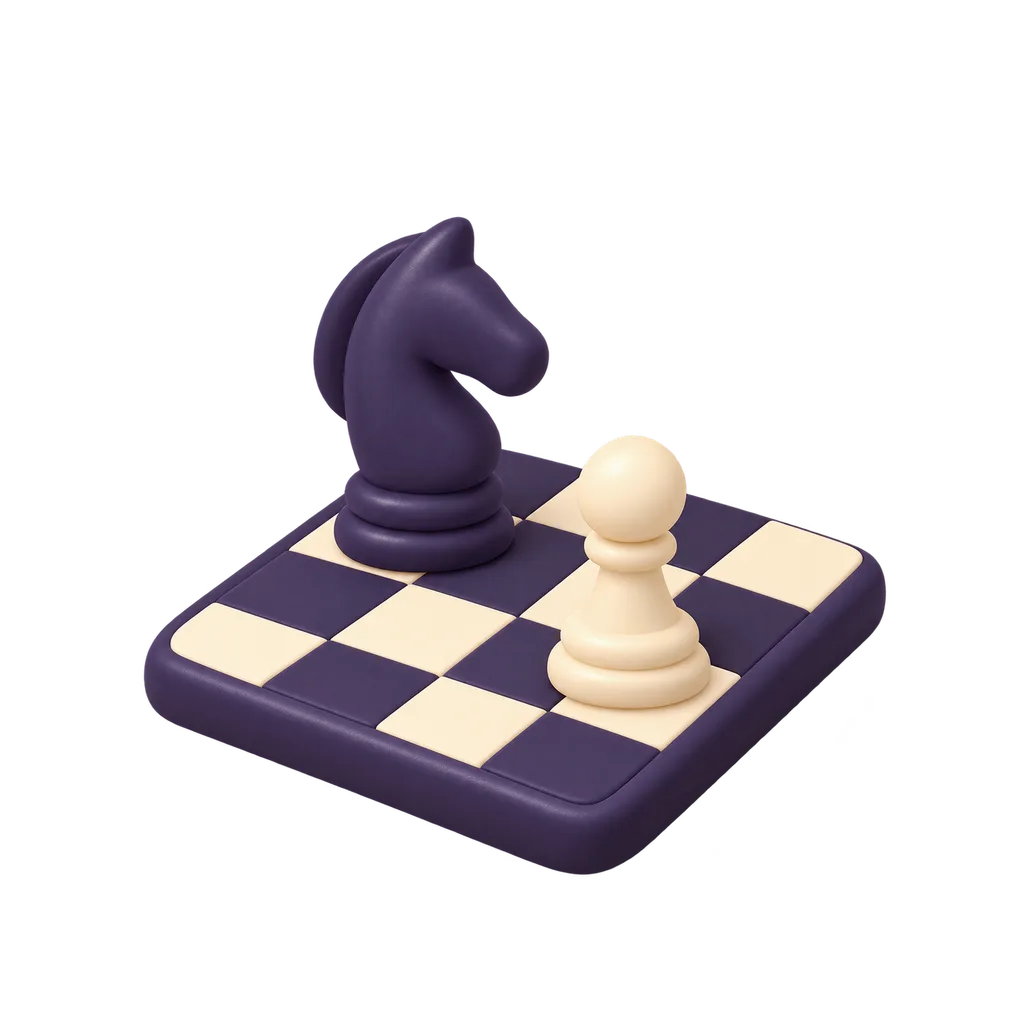
Two ways in. Play a full game against an opponent that is good enough to punish a loose move and not so good that you never win — or take three positions where one move ends the game and see whether you can find it.
The full game has all the real rules: castling, en passant, promotion, stalemate, the fifty-move rule, the lot. Drag a piece and it shows you where it can go, so you never have to remember whether that bishop was blocked.
You do not need to be good at chess for either one. You need to know how the pieces move. Everything else is looking at the whole board instead of the first thing that catches your eye, which is honestly most of what chess is.
How it works
- Drag a piece where you want it, or tap it and then tap the square.
- Lift a piece and every square it can legally reach lights up.
- In a game you can take a move back, and give up if it has gone badly.
- In the puzzles, one move is checkmate — and a wrong guess gets played out, then the real answer.
Common questions
- How strong is the opponent?
- Middling. It looks three moves ahead, then checks the captures a little deeper so it does not hang pieces at the edge of what it can see. In practice that means it will take anything you leave loose and it will find short tactics, but it has no opening book and it plays endgames poorly. A confident club player beats it; someone who plays twice a year will have a real game.
- Can I take a move back?
- Yes, in the full game. Take Back undoes your move and the reply to it, so it is your turn again in the position you had. There is no limit on it. This is a game you are playing for fun on a website, not a rated one, and learning from a blunder means being able to go back and see what you missed.
- Do I need to know chess notation?
- No. You tap the piece and then tap where it goes. The answer is shown afterwards in plain terms as well as in notation, so you can pick up the notation along the way if you want it, without needing it first.
- Is there really only one correct move?
- Yes, in every one of these. Each position was set up so that exactly one move is checkmate — other moves may be strong, or even winning eventually, but only one ends it immediately. That is what makes a mate-in-one puzzle fair to check.
- Why only three puzzles?
- Because every position here is verified by hand rather than generated, and a hand-checked puzzle with a written explanation takes real work. Three good ones beat twenty where a couple of them have a second solution nobody noticed. More will be added the same way.
- Can I play a full game against the computer?
- Not here. This is deliberately a puzzle rather than an engine — an opponent that plays properly is a much larger thing to ship, and it would make the page slow for everyone who just wanted a two-minute puzzle.
The opponent is a small search running in your browser, not a real engine and not a person. It plays a decent club-level game in the middlegame and a clumsy one in the endgame, which is a fair description of most of us. No rating is kept — the Board of Fame on the result page holds whatever name and score someone chose to save, shared with everyone who plays, and nothing more.
Okay, now pick another
 PersonalityThe Big Five Personality TestTwenty-five statements, five traits. Let’s see how you actually operate.2–4 minPersonality2–4 minThe Big Five Personality TestTwenty-five statements, five traits. Let’s see how you actually operate.Let’s see what you get
 PersonalityDecision StyleFifteen ways to see how you make a call when nobody agrees.2–3 minPersonality2–3 minDecision StyleFifteen ways to see how you make a call when nobody agrees.Let’s make a call
 TraditionWeton — Your Javanese Birth DayYour Javanese day-name, with the tradition behind it.1 minTradition1 minWeton — Your Javanese Birth DayYour Javanese day-name, with the tradition behind it.Find my weton