Party & groups · 7 min read
How to Split Teams Fairly: Random Draws, Snake Drafts and Old-School Methods
How to divide people into fair teams for five-a-side, gaming nights, group projects and team events: when to go random, when to use a snake draft, team name ideas, and how to avoid the "these teams are rigged" row.
In this article
- Why picking teams always causes drama
- Method 1: a random split (fair by process)
- Method 2: the snake draft (balanced by ability)
- Method 3: old-school playground methods
- Group work at school and university
- Which method, when?
- Choosing captains and turn order
- Team name ideas
- Worked examples: numbers that do not divide
- Splitting teams for online gaming
- How to avoid drama after the split
- Teams ready — now what?
Why picking teams always causes drama
Almost everyone has this memory: two captains pick players one at a time, and you stand there hoping not to be chosen last. It is quick, but it leaves a bad taste — and the teams are often lopsided, because captains pick their friends.
Team-picking drama turns up everywhere: Sunday football, online gaming squads, school group projects, sports days, team-building away days. The good news is that there are fairer, faster methods. The right one depends on a single question: do abilities need balancing, or not?
For a quick random split that looks fair, use pickagame's Team Maker. Type the names, choose how many teams, and watch the names dealt out one by one — with a captain and a team name for each.
Method 1: a random split (fair by process)
Random works when abilities are roughly similar, or when the point is fun rather than winning. The upside is obvious: nobody can accuse anyone of fixing it, and nobody is picked last.
What people forget is that random is fair in process, not necessarily in outcome. With eight players, the chance of the three strongest landing together is small, but real. If it happens and the game matters, re-draw. As long as everyone agreed before the draw, a re-draw is legitimate.
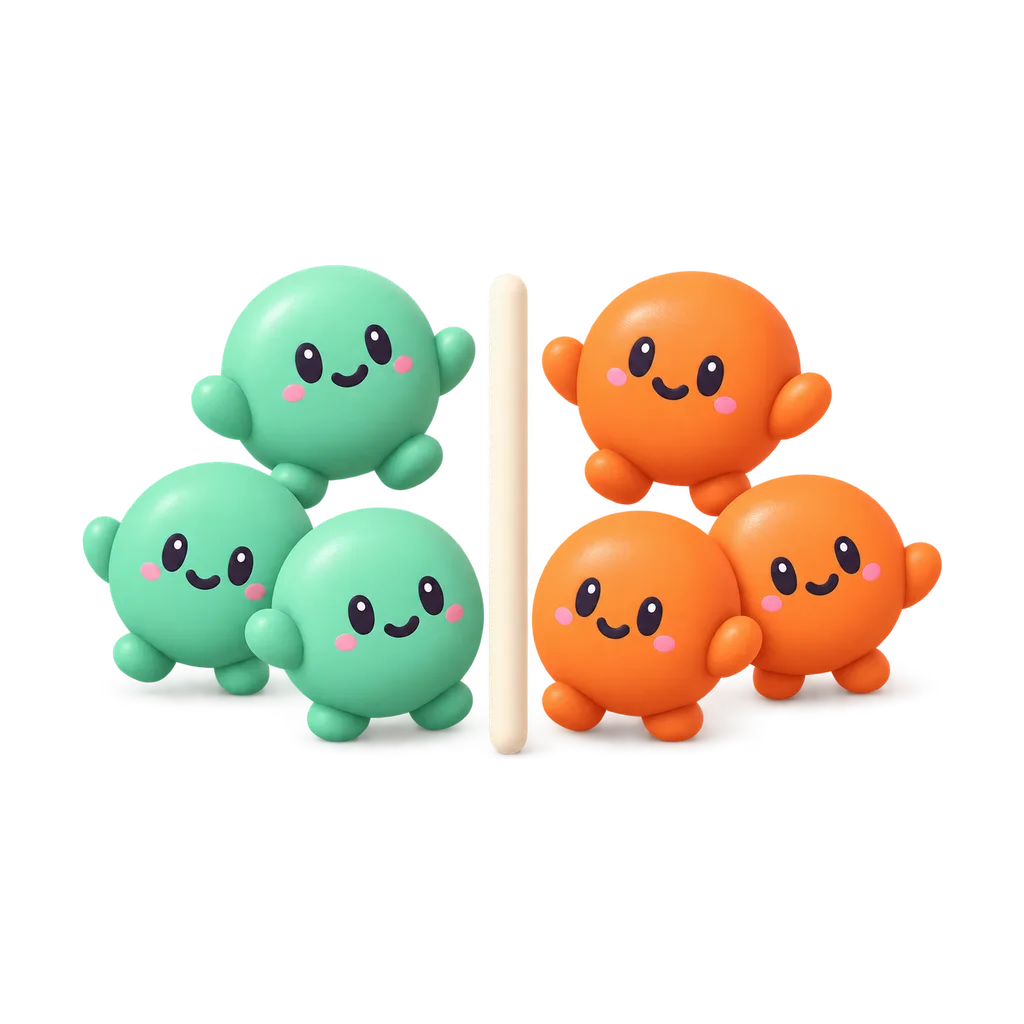
In Team Maker team sizes are balanced automatically: they never differ by more than one. Ten people in three teams gives 4, 3 and 3 — never 5, 3 and 2.
Method 2: the snake draft (balanced by ability)
For competitive games, use a snake draft. Fantasy leagues and esports tournaments use it because it takes away most of the advantage of picking first.
- Rank the players from strongest to weakest. To avoid hurt feelings, let the captains do this privately.
- Pick back and forth. For two teams the order is A, B, B, A, A, B, B, A… The team that got the best player waits two picks for its next.
- For three teams, it is A, B, C, C, B, A, A, B, C, and so on.
- The result: team strengths end up nearly equal, because every edge in one round is paid back in the next.
Method 3: old-school playground methods
Long before apps, playgrounds everywhere had their own team-making tools. Counting-out rhymes like "eeny, meeny, miny, moe" decide who is in or out. In Indonesia, children use hompimpa: everyone swings their hand and shows palm up or down at the same moment, and the minority splits off until the groups are formed. It is fast, needs nothing, and everyone accepts the result.
To decide who picks first, rock-paper-scissors is the global standard. Indonesia has its own version, suit, played with fingers: the elephant (thumb) beats the person (index finger), the person beats the ant (little finger), and the ant beats the elephant by crawling into its ear.
These are great for kids and small groups. Past ten people they get slow, which is where a digital tool becomes handy.
Group work at school and university
Group projects have a different problem from sport. The goal is not to win but for everyone to learn and for the work to get done well. The usual failures are groups made entirely of close friends, who chat more than they work, or one person doing everything while the rest put their names on it.
A random split breaks up friendship clusters and gives students the chance to work with someone new. Once groups are set, give clear roles: a lead who manages the schedule, a writer, a researcher and a presenter. In Team Maker every team gets a captain automatically, so the lead role is filled from the start.
For long projects running several weeks, consider one re-draw halfway through the term. Students learn to adapt to a different group — a skill that matters a great deal once they reach the workplace.
Which method, when?
A quick guide, for when everyone is already standing on the pitch waiting to start:
- Casual game, mixed abilities: random. Fast and nobody is offended.
- Serious match: snake draft with two captains.
- Classroom group work: random, so students learn to work outside their circle. Teachers can swap a name or two if a pairing clearly will not work.
- Team-building days: random across departments, so people who never talk end up together.
- Kids: counting rhymes or rock-paper-scissors, because the process is part of the game.
- Team quizzes: random first, then Quiz Maker. Balanced teams make a tenser quiz.
Choosing captains and turn order
Every team needs someone to lead — pick tactics, talk to the referee, or just decide who goes in goal. Team Maker marks one random captain per team, so there is no argument about who is in charge.
Often you also need a turn order: who presents first, who plays first, who takes the penalties. Team Maker's Order mode shuffles all the names into a single list. To pick just one or a few people — volunteers, raffle winners — use Pick mode, or the more dramatic spin wheel.
Team name ideas
A funny team name lifts the mood, especially when announced with a flourish. Team Maker can give fun names automatically, or you can type your own. A few ideas if you are stuck:
- Food: The Spicy Nachos, Team Extra Cheese, The Midnight Snackers.
- Animals: The Unstoppable Sloths, Night Owls, Ninja Geckos.
- Office: Per My Last Email, The Final Final Version, This Could Have Been an Email.
- Puns: Quizteama Aguilera, Let's Get Quizzical, Game of Throw-ins.
- Colours: classic and practical, especially with bibs or coloured shirts.
Worked examples: numbers that do not divide
The most common headache is a number of people that does not split evenly: thirteen people into three teams, eleven for five-a-side, twenty-three pupils into four groups. The rule is simple — divide evenly first, then spread the leftovers one per team.
- 13 people, 3 teams: 13 ÷ 3 is 4 remainder 1, so 5, 4 and 4.
- 23 pupils, 4 groups: 23 ÷ 4 is 5 remainder 3, so 6, 6, 6 and 5.
- 11 people, five-a-side: one person rotates in as a sub every ten minutes, or referees the first half.
- 7 people, 2 quiz teams: 4 against 3 is still fair for a quiz, since team size barely affects the score.
Splitting teams for online gaming
For squad games like Fortnite, Valorant or Rocket League, balance matters more because skill gaps show immediately. Communities usually run a snake draft by rank, then check each team has someone for every key role.
For a casual group with mixed abilities, random is still more fun. Stronger players can act as mentors on their own teams, and re-drawing every match stops one side losing all night.
How to avoid drama after the split
Agree the method before you split. When everyone signs up to "random" before seeing the result, complaints afterwards are far rarer. People accept an unlucky outcome when they think the process was fair — what psychologists call procedural justice.
Show the process. A split everyone watches, on a phone held up or a projector, feels fairer than a list that suddenly appears in the group chat.
Allow one swap. Let the teams make one trade if both agree. It is a safety valve for extreme cases without opening endless negotiation.
Rotate between rounds. For long events, re-draw each round so everyone plays with lots of different people.
Teams ready — now what?
Some great team games: Tebak Kata, our heads-up charades (most words in 60 seconds wins), Quiz Maker for a team quiz, or Undercover, where teamwork becomes a secret weapon. For more inspiration, read our guide to party games for groups and how to make a fun quiz.
Questions people ask
How do I split people into random teams quickly?
Type the names into Team Maker, choose the number of teams, and press go. Team sizes balance automatically and each team gets a captain.
How do I make teams balanced by skill?
Use a snake draft: rank players from strongest down, then pick back and forth (A, B, B, A, A, B…) so the first-pick advantage evens out.
What is the fairest way to pick teams?
Agree on a method before splitting, then show the process openly. Random is fairest for casual games; a snake draft is fairest for competitive ones.
Can I name the teams myself?
Yes. In Team Maker choose "Type my own" to write team names, or keep the automatic fun names.
Play something related
Keep reading
- Party & groups · 9 min readIce Breaker Games That Do Not Make People CringeThirteen ice breaker games for classrooms, offices, workshops and video calls, grouped by how much time and energy you have, plus the rules that separate an ice breaker people enjoy from one they dread.
- Party & groups · 7 min read25 Fun Group Games for Friends, Family and Work (With a Phone or Without)Group game ideas for house parties, family gatherings, office events and reunions: phone games, no-equipment games, and how to pick the right one for the room and the number of people.
- Party & groups · 8 min readHow to Play Undercover: Rules, Winning Strategy and Word Pair IdeasThe complete guide to Undercover (Who Is the Spy): how a round works, the Civilian, Undercover and Mr. White roles, how to give clues without giving yourself away, and word pairs that make great rounds.